

If you are dealing with bladder leaks, urgency, pelvic floor weakness or changes in intimate function, it is reasonable to ask: what is HIFEM treatment, and can it actually help? For many patients, the appeal is simple. It offers a non-invasive way to stimulate deep pelvic floor muscles far more intensely than most people can achieve on their own, without surgery, medication or downtime.
HIFEM stands for High-Intensity Focused Electromagnetic technology. In pelvic floor care, it is used in devices such as the EMSELLA chair to trigger thousands of supramaximal muscle contractions in a single session. That matters because the pelvic floor is not a superficial muscle group. It sits deep in the pelvis, supports the bladder and bowel, helps maintain continence, and plays a role in sexual function for both women and men.
What is HIFEM treatment?
HIFEM treatment is a medical technology designed to contract targeted muscles using focused electromagnetic energy. When applied to the pelvic floor, the treatment stimulates the nerves that cause these muscles to contract and relax rapidly and repeatedly. The contractions are much stronger and more consistent than the average person can produce with voluntary exercises alone.
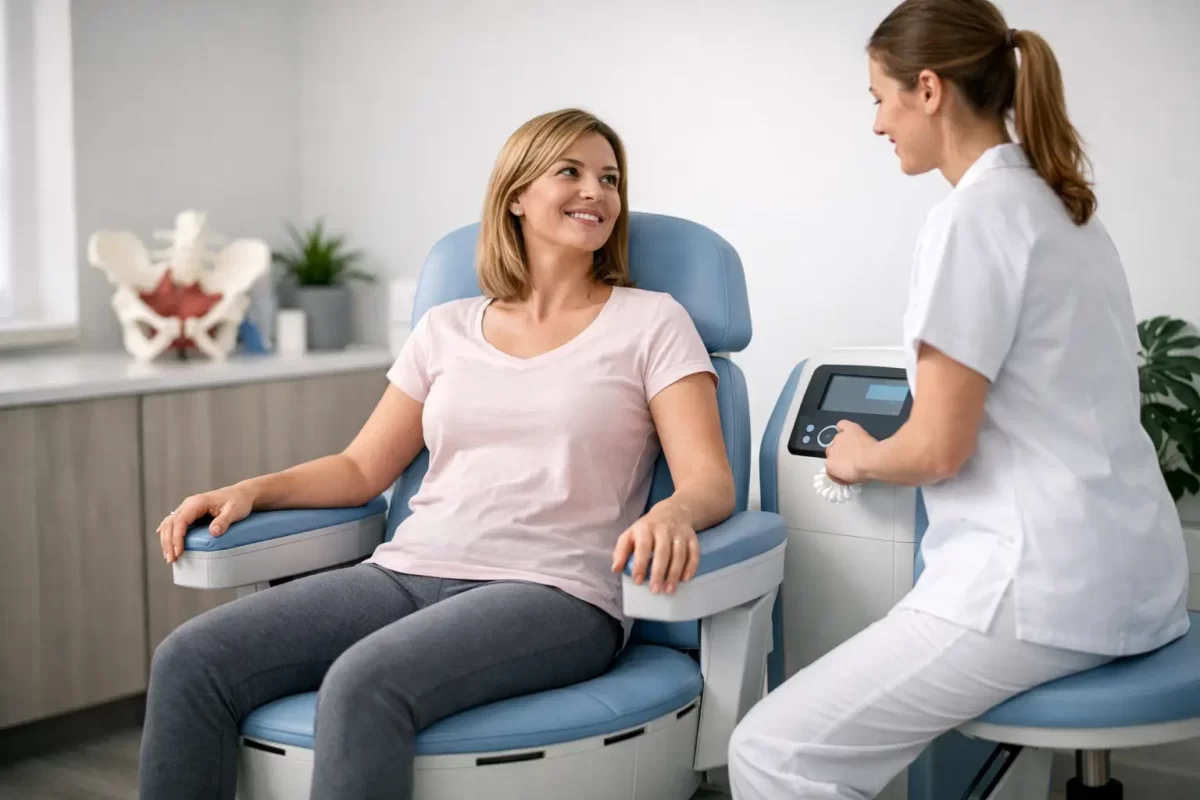
In practical terms, this means the treatment works like an advanced, device-based form of pelvic floor training. It is not massage, not heat therapy, and not surgery. Patients remain fully clothed while sitting on a treatment chair, and the technology does the work of activating the pelvic floor muscles in a controlled way.
For people who have tried Kegels and either struggled to identify the right muscles or failed to see meaningful improvement, this is often the key difference. HIFEM does not depend on guesswork. It delivers a concentrated muscle stimulus designed to improve strength, endurance and neuromuscular control.
How does HIFEM treatment work in the pelvic floor?
The pelvic floor functions like a supportive sling across the base of the pelvis. When these muscles weaken, symptoms can follow. You might notice urine leakage when coughing, sneezing or exercising. You might need to rush to the toilet more often, wake overnight to pass urine, or feel that your bladder control has become less reliable. Some patients also notice reduced vaginal tone, altered sensation, or a decline in sexual confidence. Men may experience pelvic floor weakness after prostate-related treatment or as part of erectile dysfunction management.
HIFEM treatment addresses this by causing rapid, powerful contractions that help retrain the muscles and improve their functional capacity. Over a course of treatment, the pelvic floor may become better able to support the bladder and urethra, helping reduce leakage and urgency symptoms. Better muscle tone can also support aspects of intimate wellness.
This does not mean every symptom has the same cause or that every patient will have the same result. Urinary symptoms can also be influenced by hormonal changes, childbirth injury, prolapse, neurological conditions, prostate issues, chronic constipation, weight changes and fluid habits. That is why a proper medical assessment matters before starting treatment.
What does HIFEM treatment feel like?
Most patients describe the sensation as unusual at first but not painful. During treatment, you will feel the pelvic floor muscles contracting rhythmically. The intensity is adjusted to a level that is tolerable and therapeutic. A session is typically straightforward, and because it is non-invasive, there is no anaesthetic, recovery period or time off work required.
This is one of the reasons the treatment suits busy adults. You can attend a session and return to normal daily activities straight away. For patients who want improvement without the disruption of surgery or lengthy rehabilitation, that convenience can be a major advantage.
Who may benefit from HIFEM treatment?
HIFEM treatment is most relevant for people with symptoms linked to pelvic floor weakness or poor muscle control. This often includes women after childbirth, women during or after menopause, and adults over 40 who have noticed that bladder control is no longer what it used to be.
It may also be appropriate for men, particularly those dealing with incontinence after prostate procedures or those who may benefit from better pelvic floor activation as part of intimate health support. Pelvic floor strength is not only a women’s health issue. Men rely on these muscles for bladder control and aspects of erectile function as well.
That said, suitability depends on screening. Some patients need further investigation before any device-based treatment is considered. If symptoms are caused by infection, significant prolapse, untreated neurological disease, certain implanted devices or other medical concerns, a different management plan may be needed.
What can HIFEM treatment help with?
The most common reason patients seek this treatment is urinary incontinence. That can include stress incontinence, where leaks happen with physical pressure such as coughing or lifting, and some forms of urgency-related symptoms where bladder control feels harder to manage.
HIFEM treatment may also help with pelvic floor weakness that contributes to a feeling of looseness, reduced support, or reduced confidence during intimacy. Some patients report improvements in sexual sensation and satisfaction, which is likely linked to better muscle tone and circulation in the treated area.
For men, stronger pelvic floor function may support continence and may play a helpful role in selected cases of erectile dysfunction. It is not a blanket cure, and erectile dysfunction can have vascular, hormonal, psychological and medication-related causes. Still, pelvic floor rehabilitation can be an important part of the picture for some men.
HIFEM treatment versus pelvic floor exercises
Pelvic floor exercises remain a valid first-line approach, but many people do not perform them correctly or consistently enough to get results. Even when they do, progress can be slow, especially if the muscles are already very weak or poorly coordinated.
This is where HIFEM treatment stands apart. It can generate thousands of high-intensity contractions in one session, reaching deep muscle fibres that are difficult to engage voluntarily. That may help patients build strength more efficiently than home exercises alone.
Still, it is not necessarily an either-or decision. In many cases, the best outcomes come from combining clinician-guided HIFEM treatment with advice on bladder habits, lifestyle factors and ongoing pelvic floor maintenance. Technology can accelerate progress, but good long-term outcomes still depend on treating the whole problem, not just one part of it.
Is HIFEM treatment safe?
When delivered in an appropriate clinical setting, with proper patient screening, HIFEM treatment is generally well tolerated and designed to be non-invasive. The key issue is not just the technology itself, but who is assessing you before treatment and whether your symptoms have been properly evaluated.
A doctor-led clinic offers a more careful pathway than a generic wellness model. That matters when symptoms may overlap with prolapse, urinary tract issues, post-surgical changes or other pelvic health concerns. Safe care starts with understanding why the symptoms are happening.
Patients should also know that non-invasive does not mean trivial. Bladder leakage and pelvic floor dysfunction affect sleep, confidence, exercise, intimacy and mental wellbeing. They deserve proper medical attention, not dismissal.
How many sessions are usually needed?
Most HIFEM pelvic floor treatment plans involve a course of sessions rather than a single visit. Improvement tends to build over time as the muscles adapt to repeated stimulation. Some patients notice changes early, while others need the full course before symptoms begin to shift meaningfully.
The exact number of sessions and whether maintenance is useful depends on symptom severity, baseline muscle weakness, age, childbirth history, menopause status, prostate history and overall pelvic health. This is another reason a consultation-led approach is so important. Good treatment is tailored, not one-size-fits-all.
What is HIFEM treatment really best for?
The strongest fit is for patients who want a non-surgical, drug-free option for pelvic floor rehabilitation and bladder control support. It is especially useful for people who want treatment that is practical, private and compatible with work, family life and normal routines.
It is also well suited to patients who feel embarrassed by their symptoms but are ready to address them properly. Many people delay care for years because they assume leakage is a normal part of ageing, childbirth or prostate treatment. It may be common, but that does not mean you have to put up with it.
For patients in Greater Melbourne seeking a medically guided option, consultation-led HIFEM treatment at Advance Medical Therapies can offer a more structured and reassuring path than trying to manage symptoms alone.
If you have been quietly planning your day around toilets, carrying spare pads, or avoiding exercise and intimacy because your pelvic floor no longer feels reliable, asking what is HIFEM treatment is a good place to start. The better question is whether your symptoms are telling you it is time for proper care.
Ready to take the next step?
Contact our team to arrange your Emsella consultation and discuss your symptoms, goals, and whether Emsella may be appropriate for you.
Located in Melbourne
(03) 8529 2225 | Contact Us