

How Non Invasive Continence Therapy Feels
Most people asking how non-invasive continence therapy feels are not really asking about technology. They are asking whether it will hurt, whether it will be awkward, and whether they will be able to get through a session with dignity intact. That is a fair question, especially when bladder leakage, urgency or pelvic floor weakness has already made daily life feel harder than it should.
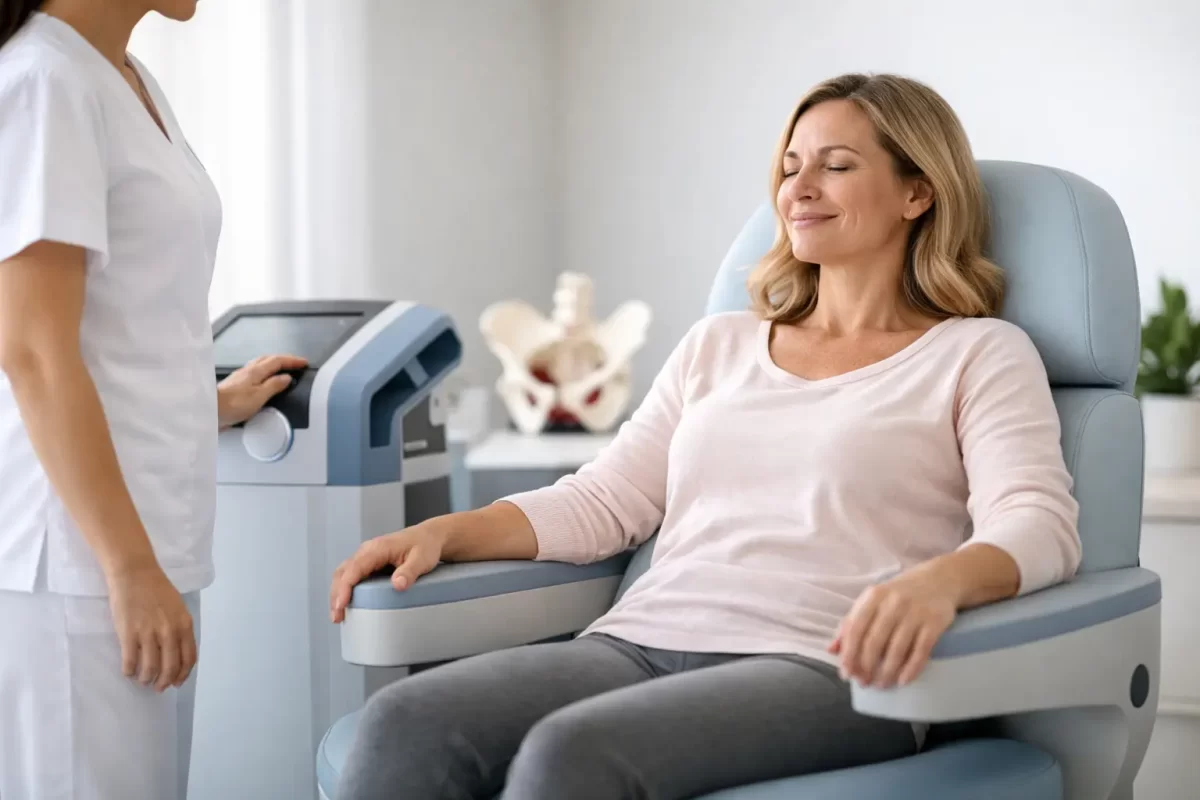
For many patients, the experience is much simpler and more comfortable than expected. Non-invasive continence therapy with the EMSELLA chair does not involve internal devices, undressing for treatment, needles, surgery or recovery time. You remain fully clothed and sit in a specialised chair while focused electromagnetic energy stimulates the pelvic floor muscles far more intensely than you can usually achieve on your own.
How non-invasive continence therapy feels during a session
The first thing most people notice is that it does not feel like a typical medical procedure. There is no physical intrusion. You sit upright on the chair, and once treatment begins, you feel rhythmic contractions and pulsing through the pelvic floor area.
Patients often describe the sensation as unusual rather than painful. It can feel like a deep internal muscle workout, with repeated tightening and lifting in the pelvic region. Some compare it to doing a very strong Kegel contraction that happens automatically, over and over again, without effort. Others notice a gentle buzzing, tapping or tingling sensation through the pelvis.
The strength of that feeling can vary. Some people feel it more in the front of the pelvis, some deeper through the pelvic floor, and some notice it around the lower abdomen or buttock area. That does not usually mean anything is wrong. It reflects your own anatomy, muscle tone and nerve sensitivity.
At the start of treatment, the intensity is usually increased gradually so you can adjust. That matters, because comfort is not just about pain. It is also about confidence. A guided, doctor-led approach helps ensure the treatment is appropriate for you and that settings are tailored to your tolerance and clinical needs.
Does it hurt?
For most patients, no. The treatment is generally well tolerated and does not involve the kind of pain people often associate with procedures for bladder problems. There are no cuts, injections or internal probes. That alone changes the experience significantly.
What you are more likely to feel is strong muscle activity. If your pelvic floor is weak, deconditioned or not working efficiently, the contractions can feel surprisingly powerful. In that sense, it may feel intense, but intense is not the same as painful.
Some patients feel mild fatigue or a heavy worked-muscle sensation during or after treatment, similar to how muscles feel after exercise. Others feel almost nothing afterwards and return straight to normal activities. It depends on your baseline pelvic floor function, the treatment settings and how aware you are of those muscles to begin with.
If something feels too uncomfortable, the intensity can be adjusted. That is one reason medical screening and supervision matter. Continence therapy should not be treated as a one-size-fits-all service.
What the sensation is actually like, minute by minute
In the first few minutes, there is often a period of adjustment. You become aware of repeated contractions that you are not controlling yourself. That can feel odd at first, simply because most people are not used to sensing the pelvic floor so clearly.
As the session continues, the treatment pattern changes. There may be phases that feel like quick pulses and others that feel like longer holds. These patterns are designed to stimulate and retrain the pelvic floor muscles in different ways. You are not expected to do anything during this time other than sit comfortably and let the device work.
By the middle of the session, many people stop feeling self-conscious and start noticing how manageable it is. They read, listen, chat or simply relax. Near the end, the muscles may feel as though they have done a substantial amount of work, even though you have been sitting still.
That is often the surprising part. The therapy feels active without being disruptive.
How non-invasive continence therapy feels afterwards
After a session, most patients can stand up and go straight back to work, driving, errands or home duties. There is no downtime, no need for pads because of the treatment itself, and no recovery period in the usual sense.
Some people notice a temporary sense of muscle fatigue, pelvic awareness or mild tingling afterwards. That usually settles quickly. Others feel no immediate after-effect at all. Neither response is unusual.
What many patients want to know is whether they will feel instant improvement in bladder control. Sometimes there is an early sense of better support or fewer urgency episodes, but results are usually progressive. Pelvic floor rehabilitation is a process. The sensation of treatment and the clinical outcome are related, but they are not identical. Feeling strong contractions during a session does not guarantee overnight change, and a gentler-feeling session does not mean it is not working.
Is it embarrassing?
This is often a bigger concern than discomfort. Continence problems can already affect confidence, intimacy, exercise and social plans. The idea of seeking treatment may feel exposing.
A non-invasive option changes that experience considerably. Because you remain clothed and there is no internal treatment during the session, many patients feel more at ease than they expected. The process is discreet, straightforward and designed to preserve dignity.
That said, embarrassment is personal. Some people feel awkward discussing symptoms such as leakage during coughing, urgency on the way to the toilet, post-birth pelvic weakness or bladder issues after prostate treatment. A clinical setting that handles these concerns every day can make a real difference. Sensitive problems are easier to address when they are treated as medical issues, not personal failings.
Why it can feel different from doing Kegels at home
Many patients have tried pelvic floor exercises on their own and are unsure whether they are doing them correctly. That uncertainty is common. The pelvic floor is not easy to isolate, and weak muscles often do not respond well to unsupervised exercise.
EMSELLA-based therapy feels different because it produces thousands of supramaximal contractions in a single session. In plain terms, it activates the muscles far beyond what most people can achieve voluntarily. That can create a clearer, stronger sensation than home exercises, especially if you have struggled to engage the right muscles before.
This is also why some patients feel hopeful after the first session. For the first time, they can actually sense the pelvic floor working. That awareness can be reassuring, particularly if they have spent months or years feeling that their body is not responding.
Who may notice stronger sensations?
People with significant pelvic floor weakness, postpartum changes, menopausal tissue changes, or bladder issues after prostate surgery may be more aware of treatment sensations at first. If the muscles are underperforming, retraining them can feel more pronounced.
Sensitivity also differs between women and men, and between one patient and the next. Body shape, pelvic anatomy, nerve sensitivity and symptom severity all play a part. There is no single correct way for treatment to feel.
What matters more is whether the treatment is appropriate for your condition and whether it is being delivered as part of a proper medical plan. At a GP-led clinic such as Advance Medical Therapies in Melbourne, assessment helps determine whether your symptoms are likely to respond and whether another cause needs attention first.
What it should not feel like
Non-invasive continence therapy should not feel frightening, invasive or overwhelming. It should not leave you unable to continue your day. And it should not be something you have to simply endure without guidance.
If a patient has concerns about pain, previous pelvic trauma, post-surgical recovery or uncertainty about whether the treatment is right for them, those issues should be discussed before starting. Good care is not only about delivering the treatment. It is about screening properly, setting expectations and adjusting the experience to the patient.
That is especially important because bladder leakage is not one condition with one cause. Stress incontinence, urgency, pelvic floor weakness and post-prostate symptoms can overlap, and the right treatment pathway depends on the individual.
The bigger picture beyond the sensation
Focusing on how the chair feels is completely understandable, but for most people, that question sits alongside a more important one – will this help me get my life back? The value of non-invasive continence therapy is not the sensation itself. It is the possibility of fewer leaks, less rushing to the toilet, better sleep, more confidence leaving the house and less planning your day around bladder symptoms.
For some patients, there are also broader benefits linked to pelvic floor strength, including improved support, better intimate confidence and a greater sense of control. Results vary, and not every symptom improves to the same degree, but the aim is practical quality-of-life change, not a temporary feeling during a session.
If you have been putting off treatment because you are worried it will be painful or embarrassing, it may help to know that most patients find the experience far more manageable than the problem they are living with. Sometimes the hardest part is not the therapy itself. It is deciding that you no longer need to put up with symptoms in silence.
Ready to take the next step?
Contact our team to arrange your Emsella consultation and discuss your symptoms, goals, and whether Emsella may be appropriate for you.
Located in Melbourne
(03) 8529 2225 | Contact Us
