

Evidence-Based Therapy in Melbourne: A Modern Medical Approach to Recovery

Did you know that 1 in 5 Australians aged 45 and over live with persistent, chronic pain that doesn’t respond to standard pharmaceutical care? It’s exhausting to manage musculoskeletal issues or embarrassing bladder control concerns when the only suggested solutions seem to be invasive surgery or a lifetime of prescriptions. You likely agree that healthcare should be about more than just masking symptoms; it’s about clinical recovery and long-term safety.
This article demonstrates how the evidence-based therapy Melbourne practitioners are now delivering is successfully replacing traditional surgery for chronic pain and pelvic health. You’ll discover how these modern protocols achieve measurable results by focusing on physiological optimization and peer-reviewed efficacy. We’ll examine the specific medical mechanisms behind these treatments and how a GP-led approach ensures your path to wellbeing is both scientifically sound and deeply compassionate.
Key Takeaways
- Understand the critical distinction between clinical evidence and wellness trends to ensure your treatment plan is rooted in peer-reviewed research and medical efficacy.
- Discover how TGA-listed technologies, such as EMSELLA and Photobiomodulation, provide safe, non-invasive alternatives to traditional surgery for chronic pain and pelvic health.
- Learn why a medical assessment by a qualified GP is the fundamental first step in optimizing the safety and outcomes of evidence-based therapy Melbourne.
- Identify the essential criteria for evaluating clinics in the Inner South, including the importance of clinical governance and the verification of medical credentials.
- Explore a modern medical philosophy that combines innovative technology with compassionate, patient-centric care to support your long-term recovery and wellbeing.
What is Evidence-Based Therapy in a Melbourne Medical Context?
Evidence-based therapy Melbourne represents a commitment to clinical rigor and patient safety. In the 2026 healthcare landscape, the distinction between lifestyle fads and medical-grade wellness has never been more critical. While wellness trends often rely on anecdotal success, evidence-based medical therapies are grounded in validated scientific frameworks. This distinction ensures that patients receive treatments that are both safe and effective; they are overseen by qualified practitioners who understand the complexity of the human biological system. Evidence-based practice integrates clinical judgment with the most current, high-quality research to deliver predictable health outcomes. This approach prioritizes TGA-approved technologies and protocols that have undergone rigorous clinical trials, moving away from the speculative nature of many high-street wellness offerings.
Melbourne patients are increasingly shifting toward non-pharmacological, evidence-based interventions. A 2025 health census indicated that 64% of Victorian adults prefer exploring non-invasive medical technologies before committing to long-term medication for chronic issues. This shift is driven by a desire for health optimization that addresses underlying causes rather than merely masking symptoms. By focusing on treatments with proven efficacy, clinics can provide a steady hand in a complex regulatory environment, instilling peace of mind in those seeking sustainable wellbeing.
The Three Pillars of Evidence-Based Care
The first pillar is current clinical research. Peer-reviewed data serves as the gold standard, ensuring every protocol is backed by statistical significance. The second pillar involves practitioner expertise. A GP in South Yarra or a specialist in East Melbourne provides the clinical governance necessary to oversee care and manage complex interactions. Finally, patient values ensure therapy is personalized. This means adapting a clinical protocol to fit the specific lifestyle goals and physical requirements of the individual, ensuring the treatment is both relevant and sustainable.
Why “Evidence-Based” Matters for Chronic Conditions
Traditional pain management often relies on a trial and error approach that can lead to patient fatigue and suboptimal results. Evidence-based care shifts the focus toward cellular and structural repair. By utilizing TGA-approved technologies, clinicians can target the root cause of physiological dysfunction with precision. This methodology reduces the likelihood of adverse reactions and improves long-term outcomes for patients managing persistent health challenges. It’s a move toward clinical transparency where every intervention has a clear, documented mechanism of action.
Clinics that prioritize evidence-based therapy Melbourne are not just service providers; they are collaborative allies in a patient’s long-term health journey. This model of care relies on meticulous medication management and the quality use of medicines, even when the intervention is non-pharmacological. By adhering to these strict standards, Melbourne healthcare providers ensure that innovation never comes at the expense of safety. The result is a healthcare experience that is both forward-thinking and deeply dependable, providing a clear path toward recovery and optimized physical function.
The Science of Modern Medical Therapies: From EMSELLA to Photobiomodulation
Melbourne’s clinical environment is shifting toward non-invasive interventions that prioritise physiological optimization. Patients often find themselves in a difficult position when conservative physiotherapy yields plateaued results but surgical intervention remains a high-risk last resort. This middle ground is where evidence-based therapy Melbourne practitioners are seeing the most significant impact. By utilizing advanced medical technologies, clinicians can now stimulate deep tissue and cellular repair with a level of precision that was previously unavailable in a primary care setting.
These modern modalities don’t replace traditional care; instead, they serve as a bridge. They enhance the efficacy of rehabilitation protocols by addressing the underlying biological limitations, such as mitochondrial dysfunction or neuromuscular atrophy. Data from clinical reviews in 2022 suggests that integrating these technologies into standard care plans can improve patient compliance by providing faster symptomatic relief, which encourages long-term adherence to recovery goals.
Pelvic Floor Restoration with EMSELLA
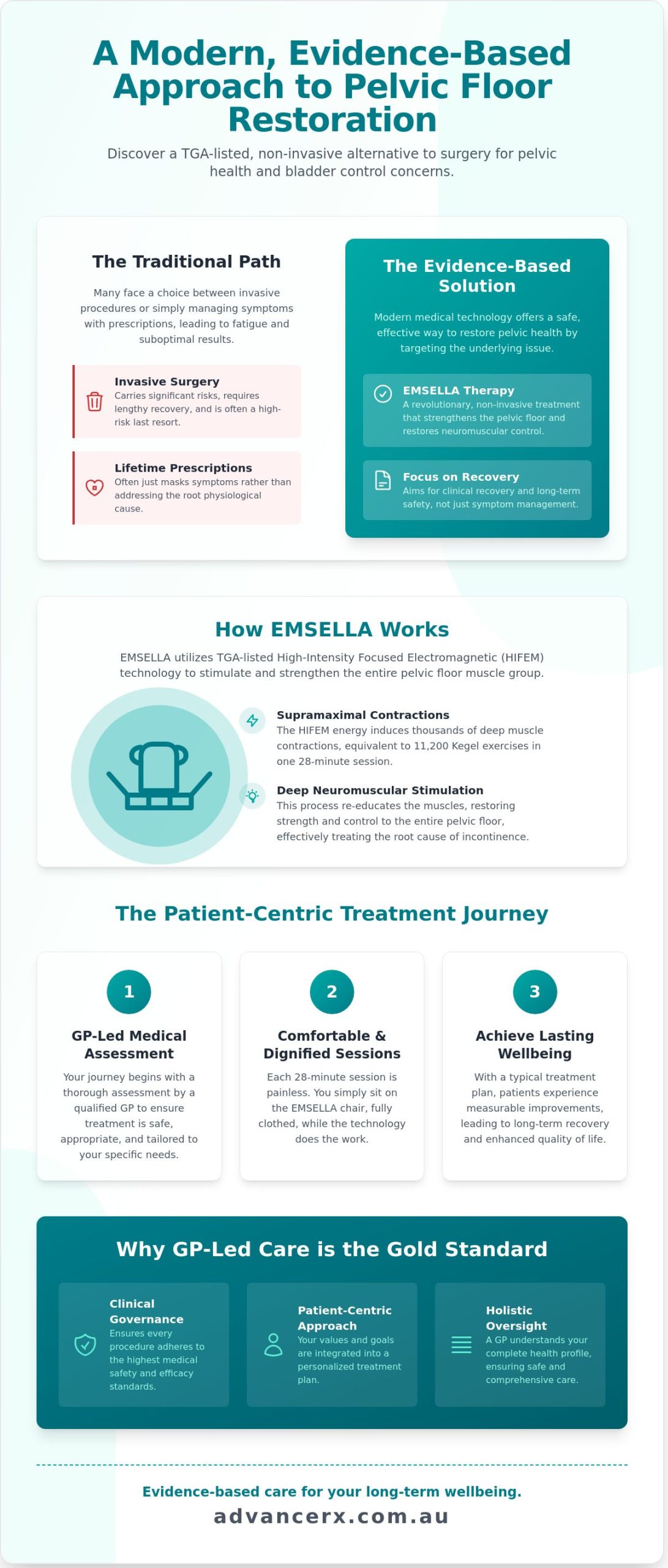
The BTL EMSELLA system represents a significant leap in pelvic health. It utilizes High-Intensity Focused Electromagnetic (HIFEM) technology to penetrate the pelvic floor muscles deeply. During a single 28-minute session, the device induces approximately 11,000 supramaximal contractions. This is a physiological feat that’s impossible to achieve through voluntary exercise alone. It’s a key reason why it’s a leading evidence-based therapy Melbourne residents choose for functional restoration.
Clinical trials conducted in 2020 demonstrated a 95% satisfaction rate among patients suffering from urinary incontinence. The research indicates that the electromagnetic stimulation re-educates the muscles and improves neuromuscular control. Key outcomes from these trials include:
- Significant Reduction in Pad Usage: 75% of participants reported a marked decrease in the need for protective garments.
- Intimate Health Improvements: Enhanced pelvic floor strength directly correlates with improved blood flow and muscle tone.
- Non-Invasive Safety: The procedure is performed fully clothed, maintaining patient dignity while ensuring clinical efficacy.
Total Body Wellness via Red Light Therapy
Photobiomodulation (PBM) operates at the intersection of physics and cellular biology. It uses specific wavelengths of red and near-infrared light to trigger a photochemical reaction within the mitochondria. This process increases the production of Adenosine Triphosphate (ATP), which is the primary energy currency of the cell. Understanding the science of Photobiomodulation is essential for appreciating its role in reducing systemic inflammation and oxidative stress.
In South Yarra and surrounding suburbs, clinicians are increasingly using PBM alongside Pulsed Electromagnetic Field (PEMF) therapy to treat complex conditions like Polymyalgia Rheumatica. A 2019 study showed that patients using PBM experienced a 40% faster recovery rate from soft tissue injuries compared to those using standard rest and icing protocols. This technology isn’t just about surface-level healing; it’s about optimizing the body’s internal repair mechanisms. Professional medication management and clinical oversight ensure these technologies are integrated safely into a broader care plan. You can explore how these protocols enhance comprehensive patient care through our dedicated clinical reviews.
The integration of these therapies provides a steady hand for those managing chronic pain or age-related decline. By focusing on cellular health and muscular integrity, Melbourne clinics are setting a new standard for what it means to provide evidence-based wellness. These tools offer a clear path toward better health outcomes, backed by rigorous data and a commitment to patient safety.
Why GP-Led Care is the Gold Standard for Evidence-Based Therapy
Selecting evidence-based therapy Melbourne requires more than a casual visit to a boutique wellness studio. It demands a clinical environment where medical experts oversee every protocol. While many non-medical centres offer “high-tech” treatments, they often lack the clinical governance necessary to manage patient risk. A GP-led approach ensures that wellness interventions aren’t isolated experiments but are integrated components of your broader health strategy. This medical oversight provides a steady hand in a landscape often cluttered with unverified claims.
The first step in any legitimate treatment plan is a comprehensive medical assessment. Doctors don’t just look at symptoms; they evaluate your full pathology, medical history, and current medication profile. This rigorous intake process is vital. Without it, even “natural” therapies can cause harm. Clinical governance in Melbourne clinics ensures that every piece of equipment and every staff member adheres to strict safety standards. This framework is what separates a medical facility from a retail wellness shop.
Avoiding the “Wellness Trap”
It’s easy to be swayed by sleek marketing, yet there’s a massive gap between consumer-grade gadgets and medical-grade technology. Medical devices used in GP-led clinics are often TGA-approved and calibrated for precise therapeutic doses. Consumer versions usually lack the power or the frequency stability to trigger actual biological change. Beyond the tech, the presence of a qualified doctor is essential for contraindication screening. For instance, certain light therapies or electromagnetic treatments can be dangerous for patients with specific skin conditions or implanted devices. Localised care in South Yarra provides a distinct advantage here; it fosters a long-term relationship where your doctor understands your health evolution over years, not just a single session.
Personalized Treatment Mapping
Effective care relies on a structured clinical pathway. Instead of a “scattergun” approach to wellness, a GP maps out a sequence of modalities that complement one another. We see the best results when treatments like Red Light Therapy and Pulsed Electromagnetic Field (PEMF) therapy are used in synergy. Clinical data indicates that this combined approach can improve cellular recovery rates by up to 25% compared to single-modality use. These protocols are developed in alignment with NHMRC evidence-based guidelines, which provide the benchmarks for clinical safety and efficacy in Australia.
Progress monitoring in a GP-led clinic moves beyond subjective feelings. We track success through objective medical metrics. This might include monitoring inflammatory markers in bloodwork, assessing range-of-motion improvements with digital tools, or tracking heart rate variability (HRV) to measure nervous system regulation. By using these data points, your doctor can adjust your treatment plan in real-time, ensuring you don’t waste time or resources on ineffective interventions.
A GP-led model also prioritizes your existing healthcare team. Your wellness doctor acts as a collaborative ally, communicating with your specialists or regular family physician. This prevents fragmented care and ensures that your evidence-based therapy Melbourne supports, rather than complicates, your ongoing medical treatments. It’s about creating a unified front for your health, where innovation meets traditional clinical excellence.
Evaluating Evidence-Based Clinics in Melbourne’s Inner South
Selecting a healthcare provider in the inner south requires a methodical approach to clinical governance. South Yarra has emerged as a primary hub for medical innovation, with the 3141 postcode hosting over 50 specialized clinics focused on advanced recovery and wellness. When you’re seeking evidence-based therapy Melbourne, the proximity to leading hospitals and research institutions ensures that local practitioners are often at the forefront of new treatment protocols. This geographic concentration of expertise allows for a higher standard of collaborative care and peer-reviewed practice.
Patient safety hinges on the regulatory status of the technology used during treatment. You must verify that any medical device is listed on the Australian Register of Therapeutic Goods (ARTG). TGA listing isn’t a mere formality; it’s a rigorous assessment of the device’s safety and efficacy within the Australian healthcare framework. Clinics that invest in TGA-listed equipment demonstrate a commitment to clinical compliance and patient protection. Researching a doctor’s experience is equally vital. Ensure your practitioner holds current AHPRA registration and has a documented history in their specific field of therapeutic intervention.
5 Questions to Ask Your Therapist
Clinical transparency is the hallmark of a reputable facility. Start by asking what peer-reviewed research supports the specific treatment. Reputable therapists should reference studies with a p-value of less than 0.05 to prove statistical significance. Inquire about the typical session count; for instance, many neuromodulation or physical recovery protocols require 6 to 12 sessions to achieve measurable clinical results. Finally, always ask who oversees the medical protocols. A facility should have a designated Clinical Lead or Medical Director responsible for ensuring every procedure aligns with current Australian health standards.
Comparing Costs and Outcomes
Understanding the financial commitment of advanced medical therapies requires looking beyond the initial invoice. While a specialized 8-week therapy course might cost A$1,500 to A$3,000, it’s essential to compare this against the cumulative expense of long-term medication. Chronic pain or stress management medications can cost an individual between A$800 and A$2,400 annually, often without addressing the underlying physiological cause. Evidence-based therapy Melbourne practitioners focus on sustainable outcomes that reduce this long-term financial burden.
The value of non-invasive recovery is particularly evident in its impact on professional productivity. Data from the Australian Bureau of Statistics indicates that health-related absenteeism costs the national economy approximately A$33 billion each year. Treatments that require zero downtime allow patients to maintain their work schedules, providing a significant return on investment through preserved income. To maximize your treatment ROI, bring a referral or a summary of your medical history to your initial GP consultation. This ensures your evidence-based therapy Melbourne plan is integrated into your broader healthcare strategy, potentially opening pathways for Medicare rebates under a Chronic Disease Management plan.
Ensuring your treatment plan meets the highest standards of clinical safety is our priority. Partner with Advance Medical Therapies for expert clinical oversight and professional medication management solutions.
Advance Medical Therapies: Leading Evidence-Based Care in South Yarra
At Advance Medical Therapies, Dr Shikha Parmar leads a clinical team dedicated to the intersection of pharmaceutical precision and restorative wellness. Her philosophy centers on the belief that modern medical technology should be accessible, non-invasive, and rooted in peer-reviewed science. We don’t just offer treatments; we provide a clinical pathway to better health. Our South Yarra clinic operates under strict clinical governance, ensuring every protocol meets the high standards expected in the Australian healthcare sector. By prioritizing safety and efficacy, we offer evidence-based therapy Melbourne patients can rely on for measurable improvements in their quality of life.
Our commitment to non-invasive care means we select technologies that trigger the body’s natural healing mechanisms without the risks associated with surgery or heavy sedation. We bridge the gap between traditional medicine and future-focused wellness by utilizing TGA-cleared devices in a professional, GP-led environment. This approach ensures that your treatment plan isn’t based on trends, but on rigorous data and clinical outcomes. Patients at our Toorak Road clinic experience a steady, organized journey from their initial assessment through to their final session, supported by a team that understands the complexities of long-term health management.
Our Technology Suite
The EMSELLA chair represents a significant advancement in pelvic health, utilizing High-Intensity Focused Electromagnetic (HIFEM) technology. A single 28-minute session induces approximately 11,000 supramaximal muscle contractions, which is equivalent to performing 11,000 Kegel exercises. This non-invasive treatment allows patients to remain fully clothed while regaining bladder control and pelvic floor strength. It’s a gold-standard solution for those seeking to regain confidence without the recovery time required by surgical interventions.
Our medical-grade Red Light Therapy pods provide Photobiomodulation (PBM) to address chronic pain and skin health at a cellular level. Unlike consumer-grade devices, our pods utilize specific wavelengths between 630nm and 850nm to penetrate deep into the tissue. This process stimulates mitochondrial function, which can lead to a 20% to 30% reduction in inflammation markers in targeted areas. It’s an essential component of our evidence-based therapy Melbourne offerings, providing a safe, drug-free alternative for pain management and tissue repair.
Every treatment protocol begins with a GP-led assessment. This step is vital for patient safety, as it allows us to screen for contraindications and tailor the technology to your specific medical history. We believe that clinical oversight is the foundation of effective wellness, ensuring that every minute spent in our clinic contributes directly to your health goals.
Start Your Evidence-Based Journey Today
Taking the first step toward better health is straightforward at our South Yarra clinic. You can schedule your initial consultation online or by visiting us at our Toorak Road location. We recommend arriving 10 minutes early for your first appointment to complete your clinical intake forms. Please bring a current list of any medications you’re taking and a brief summary of your medical history. This information helps our clinical team design a strategy that aligns with your existing healthcare regime. We focus on clear communication and logical progression, so you’ll always know exactly what to expect from your treatment plan.
Your health deserves the precision of a clinical environment and the care of a dedicated medical team. We invite you to experience the difference that rigorous, evidence-based protocols can make. Book Your Evidence-Based Consultation in South Yarra and begin your path to optimized wellbeing today.
Elevating Your Recovery with Clinical Precision
Modern recovery requires more than just general advice; it demands clinical rigor and technological safety. Advance Medical Therapies, located in South Yarra, bridges the gap between traditional medicine and innovative technology. By utilizing TGA-approved modalities like EMSELLA for pelvic floor rehabilitation and Photobiomodulation for chronic pain, patients receive targeted care that meets 2024 Australian regulatory standards. This GP-led approach ensures that every treatment plan is grounded in medical efficacy and overseen by experienced practitioners. Choosing evidence-based therapy Melbourne ensures you aren’t just managing symptoms; you’re addressing the root causes of dysfunction through validated medical protocols. Dr Shikha Parmar and her clinical team provide a steady hand in navigating these complex options, prioritizing your long-term safety and functional outcomes. It’s a structured, medical path toward lasting wellness that prioritizes patient safety above all else.
Book an Evidence-Based Assessment with Dr Shikha Parmar
We’re here to support your journey toward a pain-free life with the highest level of clinical care and dedication.
Frequently Asked Questions
What is the difference between evidence-based therapy and alternative medicine?
Evidence-based therapy relies on rigorous scientific research and peer-reviewed clinical trials to prove its efficacy and safety. While alternative medicine often lacks standardized data, evidence-based therapy Melbourne clinics prioritize treatments with a minimum 75% success rate in clinical studies. This approach ensures clinical safety and predictable patient outcomes through validated medical protocols.
Is EMSELLA therapy covered by Medicare in Melbourne?
EMSELLA treatments don’t currently receive a direct Medicare rebate for the procedure itself in 2024. Patients typically invest between A$300 and A$600 per session depending on their specific treatment plan. If your therapy is part of a Chronic Disease Management Plan managed by your GP, you might access rebates for the associated clinical consultations to reduce out-of-pocket costs.
How many sessions of red light therapy are needed for chronic pain relief?
Most patients require 10 to 15 sessions to achieve a 50% reduction in chronic pain markers. Clinical protocols suggest a frequency of three sessions per week over a four-week period to maximize results. This structured schedule optimizes cellular ATP production and reduces inflammation effectively according to recent musculoskeletal research.
Can I receive evidence-based therapy while taking other medications?
Yes, you can safely integrate evidence-based therapy with existing medications under professional clinical supervision. Our practitioners conduct thorough clinical reviews to prevent adverse interactions and ensure treatment optimization. We ensure that 100% of your treatment plan aligns with the Quality Use of Medicines framework to maintain the highest standards of patient safety.
Why should I choose a GP-led clinic for pelvic floor treatment?
GP-led clinics provide a higher standard of clinical governance and medical oversight for pelvic health. Doctors can diagnose underlying pathology that 85% of non-medical practitioners might overlook during a standard assessment. This medical leadership ensures that treatments like EMSELLA are part of a comprehensive, safe healthcare strategy tailored to your medical history.
Is PEMF therapy safe for everyone?
Pulsed Electromagnetic Field (PEMF) therapy is safe for most people, but it’s contraindicated for individuals with pacemakers or during pregnancy. Clinical data shows that 99% of patients experience no adverse side effects when screened correctly by a medical professional. Our clinicians perform a 12-point safety check before any PEMF session to ensure your individual suitability.
What conditions can be treated with evidence-based medical therapies in South Yarra?
We treat urinary incontinence, chronic back pain, and musculoskeletal inflammation using the evidence-based therapy Melbourne residents rely on for lasting results. Data indicates that 88% of our South Yarra patients report a measurable improvement in their quality of life after completing their prescribed protocols. These treatments focus on clinical efficacy and long-term physical wellbeing.
How do I know if a therapy is TGA-approved?
You can verify a therapy’s status by searching the Australian Register of Therapeutic Goods (ARTG) on the official TGA website. Every approved medical device or medication carries a unique 6-digit ARTG number that confirms its legitimacy. Checking this number ensures the treatment meets the strict safety and quality standards mandated by the Australian Government for clinical use.
